
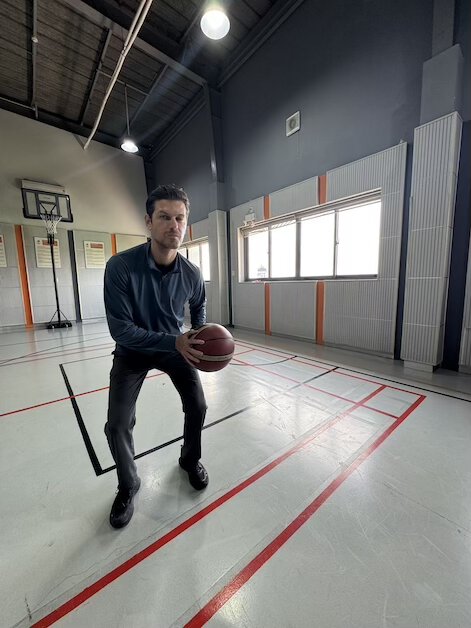
Triple Threat – Fundamental Basketball Stance
The Triple Threat is the fundamental basketball stance taught to players as soon as they start playing basketball and is used throughout their careers. It is the way you hold the ball before you start attacking. And it is known as the most efficient way for a player to handle the ball.
How Does Triple Threat Actually Help?
This stance allows players to be ready to perform all three main attacking actions in a basketball game: dribble, pass, or shoot to the basket (hence the word ‘Triple’ in the name).
For very young players, we also like to use the name “Triple Danger”, so it’s easier for them to understand what the term means.
We coach this stance from day one, because the first thing a player needs to do to start playing is to get the ball in his hands. Once he has the ball, he must know how to handle it properly and what the most efficient way to do it is.
When young players start playing basketball, at first, they don’t think about the way they hold the ball, or if it’s the best way to do it. Most of the time, they just grab the ball and start dribbling, passing or shooting without too much thought. When they join basketball academies or participate in physical education classes at school, coaches and teachers start to introduce players to the fundamentals of basketball. And fundamentals must start with the first step of foundation – holding the ball the right way. And the right way is the Triple threat hold.
Mechanics of the Triple Threat
What makes Triple Threat the most efficient basketball stance?
The best way to understand is to look at the mechanics of the Triple Threat: stance, posture, and hand placement.
Stance
This is one of the most important parts of the triple threat – and of most basketball moves in general. We always tell players: Athletic Stance. Always be well-balanced and ready to move. That means feet shoulder width apart (or slightly wider), knees bent, and the weight is shifted to the front part of the feet (balls of the feet). This stance makes us ready for action. Our legs are prepared for quick, explosive moves in any direction, and we have a low centre of gravity, so it’s not easy for a defender to throw us off balance.
Posture
Once the stance is set, the upper body must follow. Keep the back straight, head up, and eyes forward. Lean the chest and shoulders slightly ahead, but never past the toes, to maintain balance. Leaning forward signals readiness to attack and creates momentum for speed. Triple Threat is not passive – it’s an attacking stance.
Hand Placement
The final part of triple threat mechanics is how players hold the ball. Should it be chest‑high, below the waist, or off to the side? Since triple threat is designed to be the most efficient stance for dribbling, passing, and shooting, we can rule out extremes. Holding the ball at shoulder height slows down dribbling. Holding it too low at the waist delays the shooting release and weakens passing. Balance is the key. The ideal hand placement should allow a player to dribble, pass, or shoot without wasting precious time.
Hip height is the sweet spot. It keeps the ball centered on your body and balanced between your upper and lower movements. From there, lifting into a shot, bouncing into a dribble, or extending into a pass all require about the same effort. That balance makes hip‑level ball placement the most efficient and explosive option.

Players must keep the ball tucked. If the ball is too far to the side, we lose precious milliseconds while we need to bring the ball back to the sweet spot.
What I say to my players is that they should be ready to catch the ball already in triple threat position, so they can quickly perform any of the three actions that they want. If the player does not receive the ball in triple threat position, he eventually needs to bring the ball in that position, because it’s where all those three moves start.
Players should wait for the ball in an athletic stance with good posture and hand placement.
The strong hand wrist is bent and palm facing ball direction. Non-dominant hand is placed next to dominant hand, but not touching. Around 10-15 cm apart. Fingers bent, creating perfect fit for the ball to arrive.
When holding the ball, place it on the hip side that matches your dominant hand – right or left. Keep the dominant wrist bent, while the non‑dominant hand supports the ball from the side.

That brings us to the third mechanic of the Triple Threat: how players hold the ball
Notice that before we talked about hand placement on the ball, we covered two other things that are crucial for triple threat or any other move in basketball, but being overlooked by players or even coaches themselves.
“In the simplicity is the excellence”
Mastering stance, posture, and hand placement together makes Triple Threat the foundation of every attacking move.
That is why it is important to explain clearly to the players and remind them as often as needed of the importance of athletic stance and posture before even moving to hand placement on the ball. Remember that the triple threat is a fundamental part of basketball, and fundamentals are the most important part of the game. Too often, players and coaches overlook it because it seems too simple to pay much attention or spend too much time on it. But in the simplicity is the excellence. The triple threat is more than just a stance; it’s the starting point of every attacking move. It’s the tiny details in fundamentals that make all the difference. If we fail to focus on those details and neglect building a strong foundation, we risk jeopardizing a player’s entire career.
How to Teach Triple Threat to Beginners
The Triple Threat is used over and over during a basketball game. That’s why, in our daily coaching experience, the best way to teach it is by combining it with other moves — such as the Jump Stop, Passing, Shooting, and Pivoting. Teaching Triple Threat alongside these fundamentals helps players understand how the stance flows naturally into every action on the court.
We always start teaching the Triple Threat in a stationary position, with the ball held correctly. It’s crucial that coaches demonstrate the stance themselves, explaining body positioning, hand placement, and emphasizing the athletic base. Once the player is holding the ball properly in Triple Threat, we combine it with a short, simple Jump Stop.
Every Jump Stop must end in the perfect Triple Threat position — no exceptions. Each part of the stance should be checked and corrected to build a strong foundation before adding more movement. The next progression is simple: add two dribbles, then finish with a Jump Stop into Triple Threat. This way, players learn to carry the stance from stationary drills into live movement.
Lastly, we combine these moves together and add passing to work in pairs. The sequence is simple: start with dribbling, finish with a jump stop, then pivot and pass to your partner. It’s important that while pivoting, players maintain the Triple Threat position — this drill is designed to reinforce that habit. (Note: this applies only while practicing Triple Threat, not during a rip‑through move.)
Triple Threat is where it all starts. From the first day, I want my players to know how to hold the ball, stay balanced, and be ready. Mastering the Triple Threat stance is the foundation of becoming a confident basketball player. Players must learn this so it becomes second nature to them and so they can dribble, pass, or shoot without hesitation. Coaches who emphasize these mechanics early give their athletes the tools to play fast and more efficiently. Triple Threat isn’t just a stance – it’s the starting point for every move in the game