
The 17 Laws of The Football Game – 2025/26 – A Complete Guide
Law 1: The Field of Play
Football begins with the field itself. Law 1 sets the standards for the playing area so matches are consistent and safe everywhere in the world.
The field can be natural grass, artificial turf, or a hybrid system, but artificial surfaces must be green and meet FIFA’s quality standards for international matches. The pitch must be rectangular, with clear markings for touchlines, goal lines, the halfway line, center circle, penalty areas, and corner arcs.
Dimensions vary depending on the level of play. For most matches, the touchline ranges from 90–120 meters and the goal line from 45–90 meters. At international level, the requirements are stricter: touchlines must be 100–110 meters and goal lines 64–75 meters. Goals are set at 7.32 meters wide and 2.44 meters high, painted white, and firmly secured for safety.
Beyond the field, Law 1 also defines the technical area for coaches and substitutes, requiring responsible behavior. Matches using VAR must have a Video Operation Room and a Referee Review Area. Technology such as Goal Line Technology is permitted, but advertising is banned on the field, goals, nets, and flagposts during play.
Referees inspect the field before matches and decide if conditions are safe. At lower levels, common sense applies, games can continue even if minor details like corner flags or markings are missing, as long as safety is not compromised.
Law 2: The Ball
Law 2 defines the most important piece of equipment in football – the ball. To ensure fairness, every ball used in a match must meet strict standards.
It must be spherical, made of suitable material, measure 68–70 cm in circumference, weigh 410–450 g, and have the correct pressure. For official competitions, balls must carry one of three FIFA marks: Basic, Quality, or Quality Pro, showing they have passed technical testing. Advertising on the ball is limited to the competition logo, organizer, and manufacturer’s trademark.
If a ball becomes defective during play, the referee stops the match and restarts with a dropped ball. If it happens during a restart, the restart is retaken. For penalty kicks, if the ball fails before reaching another player or the goal frame, the kick is retaken.
National associations can modify the size, weight, or material of the ball for youth, veterans, disability, and grassroots football to make the game more accessible. Referees are responsible for checking balls before matches, and they cannot be held liable for issues with the ball’s suitability. To keep the game flowing, extra balls may be placed around the field, but they remain under the referee’s control.
The Foundation of the Game
Together, Laws 1 and 2 create the stage and the instrument of football. They ensure the game is played on safe, consistent fields with reliable equipment, while still allowing flexibility for youth and grassroots levels. By combining universality with practical adjustments, these Laws protect fairness and keep football accessible to everyone.
Law 3: The Players
Football is ultimately about the players on the pitch, and Law 3 sets the rules for team composition, substitutions, and responsibilities. Each team can have up to eleven players, with one acting as the goalkeeper. A match cannot continue if a team drops below seven players, ensuring fairness and safety.
Substitutions are carefully managed. In official competitions, teams can make up to five changes, but only during opportunities in play to avoid disrupting the flow. Extra time allows unused substitutes to carry over, and some competitions permit one additional change. At grassroots levels, return substitutes are allowed, meaning a player who was taken off can rejoin later.
The 2025/26 season emphasizes safety and respect. Teams may use one permanent concussion substitution per match, separate from normal limits, with the opposing team granted an extra change to keep things fair. Captains must wear an armband and carry responsibility for their team’s behavior. The “only the captain” guideline encourages respectful communication with referees after major incidents.
Law 3 also covers procedures and sanctions. Substitutions must be reported to the referee, and players should leave by the nearest boundary unless safety requires otherwise. If extra persons interfere with play, restarts are adjusted, and goals scored with unauthorized players on the field can be disallowed. Substitutes and team officials remain under the referee’s authority and can be cautioned or sent off.
Law 4: The Players’ Equipment
Law 4 ensures players are properly equipped for safety, identification, and professionalism. No player may wear anything dangerous, and jewelry is strictly forbidden. Before matches, referees and officials inspect players and substitutes to confirm compliance.
Compulsory equipment includes a shirt with sleeves, shorts, socks, shinguards, and footwear. Tape on socks must match the color of the area it covers. Captains must wear an armband, which may be issued by the competition or feature a simple “C” or “captain” marking.
Colors must distinguish teams from each other and from match officials. Goalkeepers must wear unique colors, and undergarments must match the main kit. Protective gear such as padded headgear or sports spectacles is allowed if safe. Electronic devices are generally banned, except for approved wearable technology under FIFA’s Quality Programme. Team officials may use small devices for coaching or welfare but risk sanctions if misused.
Equipment must remain neutral. Political, religious, or personal slogans are prohibited, while names, numbers, and team crests are permitted. Referees enforce these rules by requiring players to leave the field to correct issues, only allowing re‑entry once equipment is checked. Players who refuse to comply or re‑enter without permission are cautioned.
The Human Element of Football
Together, Laws 3 and 4 define the human side of the game, who plays, how they are managed, and what they wear. These rules protect fairness, safety, and respect, while maintaining the image of football worldwide. By combining strict standards with practical flexibility, the Laws ensure players can compete responsibly and safely at every level.
Law 5: The Referee
The referee is the ultimate authority on the field, responsible for enforcing the Laws and protecting the spirit of the game. Their decisions about goals, match results, and incidents are final, and all participants are expected to respect them—even when they are debated. Referees are also expected to use common sense, especially at lower levels, to keep matches playable despite minor technical issues.
For the 2025/26 season, several updates highlight transparency and player safety. Referees must now enforce an eight‑second limit for goalkeepers holding the ball, with a visible countdown using their fingers. In competitions with VAR, referees can publicly announce and explain decisions after reviews, improving communication with fans. They also have more discretion when restarting play with a dropped ball, giving possession to the team that would clearly have gained it.
Managing participant behavior is another focus. Referees are encouraged to interact mainly with captains after major incidents, reducing crowding and improving respect. In grassroots football, they can signal a “captain‑only zone” to control interactions. Their authority to issue sanctions begins with the pre‑match inspection and lasts until they leave the field, covering the entire match and penalty shoot‑outs.
Player safety remains central. Referees must stop play for serious injuries, support medical staff during head injury assessments, and ensure concussion substitutions are handled fairly. They carry whistles, cards, and notebooks, but may not wear jewelry or electronic devices. Communication relies on approved signals and body language to show authority and self‑control.
Law 6: The Other Match Officials
Law 6 defines the team of officials who support the referee. They are divided into two groups: on‑field officials and video officials. All operate under the referee’s authority.
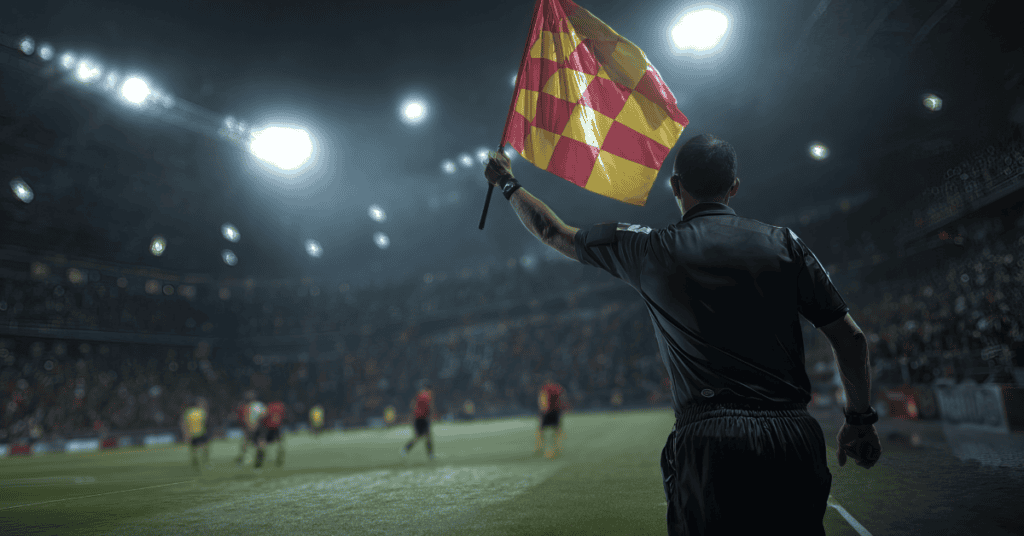
On‑field officials include two assistant referees (ARs), the fourth official, two additional assistant referees (AARs), and a reserve assistant referee. ARs monitor offside, ball out of play, and substitution procedures. The fourth official manages the technical area, supervises substitutions, and indicates added time. AARs assist with goal decisions and incidents near the penalty area, while the reserve AR steps in if another official cannot continue.
Video officials consist of the VAR and AVAR. They review footage to correct clear and obvious errors or serious missed incidents in four categories: goals, penalties, direct red cards, and mistaken identity. The VAR communicates findings to the referee, while the AVAR monitors live play and helps manage communication.
Officials collaborate through practical guidelines. Referees use a diagonal system to keep play between themselves and the lead AR, while ARs stay in line with the second‑last defender or the ball. For penalty kicks, ARs may adjust positioning when technology like VAR or Goal Line Technology is in use. Communication tools include flags, whistles, and electronic systems such as headsets.
Law 6 also emphasizes behavior and safety. Officials assist referees in enforcing the “only the captain” guidelines and managing technical area occupants. They are protected from liability for decisions made in line with the Laws, ensuring the integrity of their role.
The Officials’ Role in Modern Football
Together, Laws 5 and 6 establish the authority and teamwork needed to control matches fairly and safely. The referee leads, supported by a structured team of officials and modern technology. With new measures for transparency, behavior management, and player welfare, the 2025/26 Laws strengthen respect for officials and ensure football continues to be played in the right spirit at every level.
Law 7: The Duration of the Match
Law 7 sets the time framework for football, ensuring matches are played fairly and consistently worldwide. A standard game lasts two halves of 45 minutes each, with a half‑time break of up to 15 minutes. In matches requiring extra time, a short drinks break is permitted between the halves.
Referees must add stoppage time to account for delays such as substitutions, injuries, disciplinary actions, VAR checks, goal celebrations, or cooling breaks in hot weather. Only excessive delays are added. Routine stoppages like throw‑ins or goal kicks usually are not. The referee is the primary timekeeper and has the final say on how much time is added. Once announced, added time can be increased but not reduced. The fourth official signals the minimum additional time at the end of each half.
Special rules apply in certain cases. If a penalty is awarded at the end of a half, play is extended until the kick is completed. Abandoned matches are usually replayed unless competition rules state otherwise. For youth, veterans, disability, and grassroots football, national associations may shorten halves to suit participants.
By balancing strict timekeeping with flexibility, Law 7 ensures fairness and integrity, preventing tactics like excessive celebrations or goalkeeper time‑wasting from reducing the opponent’s chance to play.
Law 8: The Start and Restart of Play
Law 8 governs how matches begin and how play resumes after stoppages. The most common restart is the kick‑off, used at the start of each half, extra time, and after goals. A coin toss decides which team kicks off first, and players must stay in their own half until the ball is in play. A goal can even be scored directly from a kick‑off.
The dropped ball procedure has been updated for 2025/26 to improve fairness. If play stops inside the penalty area, the ball is dropped only for the defending goalkeeper. Outside the penalty area, the referee now gives the ball to the team that clearly would have gained possession, rather than automatically to the team that last touched it. If possession is unclear, it goes to the last team to touch the ball. All other players must stay at least four meters away until the ball touches the ground.
Dropped balls are used when play stops for reasons like injuries, defective balls, or outside interference, provided no offence occurred. If the referee mistakenly stops play, the restart is always a dropped ball. Importantly, once play resumes, kick‑offs and dropped balls cannot be reviewed by VAR.
Flow and Fairness
Together, Laws 7 and 8 define the rhythm of football, how long matches last and how play is restarted. They ensure time is managed fairly, restarts are handled consistently, and the game flows smoothly. With updates for 2025/26, these Laws reinforce fairness, integrity, and respect for the spirit of the game, keeping football enjoyable and balanced at every level.
Law 9: Ball In and Out of Play
Law 9 defines the two basic states of the ball, whether it is in play or out of play. This distinction is crucial because most rules, including fouls and misconduct, only apply when the ball is officially in play.
The ball is out of play when it has completely crossed the goal line or touchline, whether on the ground or in the air, and in those cases play restarts with the normal methods (throw‑in, goal kick, or corner kick depending on how it left the field). Separately, if the referee stops play for another reason, or if the ball touches a match official and this directly causes a promising attack, a goal, or a change of possession, then play does not continue with “advantage” — instead, the referee halts play and restarts with a dropped ball to restore fairness.At all other times, the ball is considered in play, even if it rebounds off the goalposts, crossbar, or corner flag.
A new update for 2025/26 clarifies situations where substitutes, team officials, or players temporarily off the field touch the ball as it is clearly leaving the pitch. If there was no intent to interfere unfairly, the restart is an indirect free kick to the opposing team, but no disciplinary action is taken.
Law 9 also connects directly to other Laws. For example, goals under Law 10 are only valid if the ball was in play when it crossed the line. Offences committed while the ball is out of play still result in disciplinary action, but the restart remains unchanged. VAR can review whether the ball was out of play before a goal or penalty incident, but once play has restarted, the decision cannot be reviewed.
Law 10: Determining the Outcome of a Match
Law 10 sets the criteria for deciding who wins a match. A goal is awarded only when the entire ball crosses the goal line between the posts and under the crossbar, provided no offence was committed by the scoring team and the ball was in play. If a goalkeeper throws the ball directly into the opponent’s goal, it does not count, and play restarts with a goal kick.
The team that scores more goals wins. If both teams score the same number or none, the match is a draw. When competition rules require a winner, the permitted methods are the away goals rule, extra time (two halves of up to 15 minutes), or penalties.
Penalty shoot‑outs, formerly called “kicks from the penalty mark,” follow strict procedures. Only players on the field at the end of the match (or temporarily off for injury/equipment) may take part. Warnings and cautions do not carry over into the shoot‑out, but players sent off during the match remain ineligible. If one team has more players, they must reduce their numbers to match the opponent before the shoot‑out begins. Injured goalkeepers may be replaced by eligible players or substitutes, but a sent‑off goalkeeper must be replaced by another eligible player.
Kicks are taken alternately, and if the score is level after five each, play continues until one team scores more from the same number of kicks. Goal Line Technology supports referees in confirming whether the ball fully crossed the line, and VAR can review offences or ball‑out‑of‑play situations in the build‑up to a goal. Ultimately, the referee’s decision on whether a goal is valid and the match result is final.
Fairness and Integrity
Together, Laws 9 and 10 define the most fundamental aspects of football: when the ball is in play and how goals decide the outcome. These rules ensure fairness, prevent disputes, and uphold the integrity of the game. With updates for 2025/26, they reinforce clarity and consistency, keeping football balanced and respected across all levels.
Law 11: Offside
Offside is one of football’s most technical rules, designed to prevent players from gaining an unfair advantage by positioning themselves too close to the opponent’s goal.
A player is in an offside position if any part of their head, body, or feet is in the opponents’ half and closer to the goal line than both the ball and the second‑last opponent. Hands and arms are not considered—only up to the armpit. Importantly, being in an offside position is not an offence by itself. A player is penalised only if they become involved in active play when the ball is played by a teammate.
Active play includes touching the ball, interfering with an opponent’s ability to play, or gaining an advantage after the ball rebounds off the goal frame, a match official, or is deliberately saved by an opponent.
For 2025/26, a new clarification applies to goalkeeper throws: the last point of contact is now used to judge offside, making decisions clearer. Exceptions remain—there is no offside offence when receiving the ball directly from a goal kick, throw‑in, or corner kick. If an offence occurs, play restarts with an indirect free kick at the spot of the offence.
Assistant referees are key to enforcing offside, staying in line with the second‑last defender or the ball. VAR also checks offside in the build‑up to goals or penalties. If a foul occurs before an offside offence, the foul is penalised; if the offside comes first, that takes precedence.
Law 12: Fouls and Misconduct
Law 12 provides the disciplinary framework that keeps football safe and fair. It defines offences, sanctions, and restarts.
A major update for 2025/26 is the goalkeeper time limit. Goalkeepers may now hold the ball for up to eight seconds (previously six). If they exceed this, the restart is a corner kick for the opponents. To ensure transparency, referees visibly count down the last five seconds with a raised hand.
Direct free kicks are awarded for physical offences such as charging, tripping, or kicking, depending on whether the action was careless, reckless, or used excessive force. Handball offences also result in direct free kicks, except for goalkeepers in their own area. Indirect free kicks are given for non‑contact offences like dangerous play, impeding without contact, dissent, or offensive language.
Referees can issue yellow cards (cautions) for offences like delaying restarts, dissent, persistent fouls, or unsporting behavior such as simulation. Red cards (send‑offs) are given for serious foul play, violent conduct, spitting, biting, or denying an obvious goal‑scoring opportunity (DOGSO).
DOGSO has special provisions. If the offence occurs in the penalty area and the player was attempting to play the ball, they are cautioned. If the offence involved holding, pushing, or no chance of playing the ball, they are sent off. Outside the penalty area, DOGSO always results in a red card.
Law 12 is central to managing poor participant behavior. It works alongside the “only the captain” guidelines to reduce dissent and protect referees. VAR supports referees only in direct red card decisions or mistaken identity cases.
Fairness, Safety, and Respect
Together, Laws 11 and 12 balance technical precision with discipline. Offside ensures fairness in attacking play, while fouls and misconduct rules protect safety and integrity. With updates for 2025/26, these Laws reinforce respect for officials, transparency in decisions, and the spirit of the game across all levels of football.
Law 13: Free Kicks
Free kicks are one of the main ways football restarts after an offence. They ensure fairness by penalising the offending team while giving the opponents a chance to resume play.
There are two types:
- Direct free kick: A goal can be scored directly against the opponents.
- Indirect free kick: The ball must touch another player before a goal can be scored. If it goes straight into the goal, play restarts with a goal kick.
The ball must be stationary before the kick, and the kicker cannot touch it again until another player does. Creative techniques like feinting are allowed, as long as they are not deceptive in an illegal way.
Opponents must stay at least 9.15 meters away. If three or more defenders form a wall, attackers must remain at least one meter from it. Violations result in an indirect free kick for the defending team.
Free kicks link closely with other Laws. For example, if a direct free kick offence occurs inside the penalty area, it becomes a penalty kick under Law 14. Referees and assistant referees manage distances and positioning, while VAR cannot review free kick decisions once play has restarted.
Law 14: The Penalty Kick
Penalty kicks are awarded when a direct free kick offence occurs inside the defending team’s penalty area. They represent the ultimate sanction for defensive fouls.
The procedure is strict:
- The ball must be on the penalty mark.
- The kicker must be identified before the whistle.
- The goalkeeper must stay on the goal line, facing the kicker, with at least part of one foot on or behind the line.
- All other players must remain outside the penalty area, behind the mark, and at least 9.15 meters away.
The ball is in play once it moves forward. If a penalty is awarded at the end of a half, time is extended until the kick is completed.
Infractions are handled carefully. Illegal feints or wrong kickers result in cautions and indirect free kicks. Goalkeeper offences lead to retakes if they clearly affected the kicker, with warnings or cautions depending on repetition. Encroachment by teammates can also lead to retakes or indirect free kicks depending on the outcome.
Penalty kicks tie into other Laws. Law 12 defines the “double jeopardy” rule, where players committing DOGSO offences in the penalty area may be cautioned instead of sent off if they attempted to play the ball. VAR can review penalty decisions, including offences in the build‑up or goalkeeper/kicker actions.
Fairness and Sanction
Together, Laws 13 and 14 define how football penalises offences and restores fairness. Free kicks provide balance for most fouls, while penalty kicks deliver the strongest sanction for defensive infractions in the penalty area. With clear procedures and updated rules for 2025/26, these Laws reinforce fairness, transparency, and respect for the spirit of the game.
Law 15: The Throw‑in
The throw‑in is one of football’s simplest restarts, awarded when the ball has completely crossed the touchline. It ensures play resumes fairly and consistently.
The procedure is clear: the thrower must face the field, keep part of each foot on or outside the touchline, and deliver the ball with both hands from behind and over the head. The ball is in play once it enters the field. If thrown incorrectly, the opponents retake it. Goals cannot be scored directly from a throw‑in—if the ball enters the opponents’ goal, it becomes a goal kick; if it enters the thrower’s own goal, it becomes a corner kick.
Disciplinary measures apply if opponents fail to respect the required two‑meter distance or unfairly distract the thrower. The thrower cannot touch the ball again until another player does. Referees also caution players who delay restarts by pretending to take a throw‑in and then leaving it for a teammate.
Strategically, throw‑ins carry two key exceptions: there is no offside offence when receiving the ball directly from one, and goalkeepers cannot handle the ball if it comes directly from a teammate’s throw‑in. Match officials, especially assistant referees, play a vital role in signaling throw‑ins, while VAR cannot review restart decisions once play resumes.
Law 16: The Goal Kick
The goal kick restarts play when the ball crosses the goal line, last touched by an attacker, without a goal being scored. It is a fundamental restart that interacts with offside and other Laws.
The ball must be stationary and kicked from anywhere inside the goal area by a defending player. It is in play once it clearly moves, and opponents must remain outside the penalty area until then. A goal can be scored directly against the opponents, but if the ball goes straight into the kicker’s own goal, the opponents are awarded a corner kick.
Strategically, there is no offside offence from a goal kick, allowing teams to stretch the field. However, players are cautioned if they attempt tricks to bypass the back‑pass rule, such as flicking the ball to themselves before heading it back to the goalkeeper.
Offences include double touches, encroachment, or fouls before the ball is in play. In such cases, the kick is retaken, and disciplinary action may follow. Referees signal goal kicks by pointing toward the goal area, while assistant referees check ball placement and then position themselves to judge offside.
Law 16 also links with other Laws. For example, if a dropped ball enters the opponents’ goal without touching two players, play restarts with a goal kick. VAR can check if the ball was out of play before a goal or penalty incident, but the award of a goal kick itself is not reviewable.
Natural Restarts and Fair Play
Together, Laws 15 and 16 define two of football’s most common restarts. They ensure play resumes naturally, fairly, and without unnecessary delay. With updates for 2025/26, these Laws reinforce discipline, protect fairness, and maintain the flow of the game across all levels of football.
Law 17: The Corner Kick
The corner kick is awarded when the ball wholly crosses the goal line, last touched by a defending player, without a goal being scored. It is one of football’s most familiar restarts, but in the 2025/26 edition it takes on an expanded role as part of the new goalkeeper time‑wasting rule.
The 8‑Second Rule Connection
A major update links Law 12 (Fouls and Misconduct) with Law 17. If a goalkeeper holds the ball with their hands for longer than eight seconds, the penalty is now a corner kick for the opponents, taken from the corner nearest to where the offence occurred. Trials showed this was a stronger deterrent than the old indirect free kick inside the penalty area, and easier for referees to manage.
Standard Procedure
- The ball must be stationary and placed inside the corner arc (a 1‑meter radius).
- It is in play once it is kicked and clearly moves; it does not need to leave the arc.
- Corner flagposts are compulsory and cannot be moved.
- Defenders must stay at least 9.15 meters away until the ball is in play, with optional marks allowed to help measure this distance.
Scoring and Tactical Rules
- A goal can be scored directly against the opponents from a corner kick.
- If the ball is kicked directly into the kicker’s own goal, no goal is awarded; instead, the opponents receive a corner kick.
- There is no offside offence if a player receives the ball directly from a corner.
- The kicker cannot touch the ball again until another player does; violations result in an indirect free kick (or a direct free kick for handball).
Match Officials and VAR
Assistant referees signal when a corner should be awarded, while referees use a specific arm signal pointing toward the corner area. ARs position themselves behind the flag to check ball placement and judge if it crosses the line. Referees are reminded to deal firmly with holding offences, which often occur during corners.
VAR cannot review the decision to award a corner once play has restarted, but it can check whether the ball was out of play before a goal or penalty incident.
nteraction with Other Restarts
Law 17 also acts as the “safety restart” when the ball enters a team’s own goal directly from other restarts where scoring is not allowed—such as kick‑offs, dropped balls, free kicks, throw‑ins, or goal kicks.
Fairness and Flow
Law 17 ensures one of football’s most common restarts is handled consistently and fairly. With the 2025/26 update linking it to goalkeeper time‑wasting, the corner kick now plays a bigger role in protecting match flow and discouraging unsporting delays, reinforcing the game’s integrity at every level.