
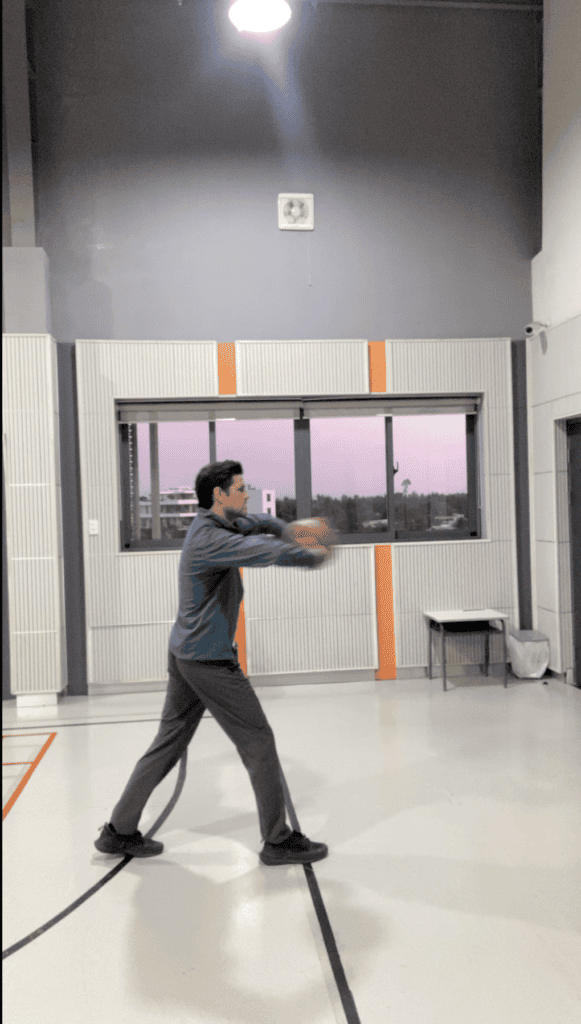
Basketball Passing Fundamentals
While shooting and dribbling get most attention, passing is the underrated foundation of true team basketball.
You can beat a defender with dribbling skills, but that’s not enough to beat the whole team. To do that, you need help. You need your teammates. And to get help from them, you need to share the ball with them. You need to pass.
There are different ways to pass the ball, but all of them have one purpose – to find an open teammate.
We will cover 5 fundamental basketball passes: chest pass, bounce pass, overhead pass, baseball pass, and one-hand push pass; show you the correct technique for each pass and explain the right situation to use a particular pass.
Why Passing Is the Most Important Skill in Basketball
Basketball Is a Team Sport
Basketball is a team sport. A basketball coach’s job is to build a team that works together as one unit. That’s the goal for every coach. Selfishness has no place on a team that wants to win championships. And to achieve that, the players need to work together. To sync their defence and offence, cover each other, but most importantly, pass the ball to each other.
Even Best Players Rely on the Pass
Even the best players, who score 30, 40 points a game, depend on their teammates. Most of their baskets come after a pass. Scoring opportunities are created when the ball moves quickly, finding the open player. Passing is the foundation of every great offensive play.
Passing Is Essential – But Easy to Neglect
At first glance, passing seems simple. Beginners often assume they’ve mastered it after a little practice. But in reality, poor technique leads to rushed passes, turnovers, and missed opportunities. Coaches must emphasize the details, footwork, timing, accuracy, and decision-making, because sloppy passing can ruin a team’s rhythm.
During our daily basketball sessions, we noticed that a bit more advanced youth basketball players at around 14-15 years old tend to show less enthusiasm for passing drills, they see passing as boring compared to shooting or dribbling. That’s why it’s critical for coaches to instill a team-first mindset early. Players need to understand that strong passing mechanics reduce turnovers, create scoring chances, and elevate the entire team’s performance.
Type of Basketball Passes
As mentioned earlier, there are 5 fundamental types of basketball passes: chest pass, bounce pass, overhead pass, baseball pass and one-hand push pass.
Some of them are more often used than others, but all are needed in a basketball game and must be known by every basketball player.
Chest Pass
We always start to teach passing to our basketball players with the chest pass. It is one of the most common types of passes, and the easiest for beginner basketball players to understand. It is called a chest pass because it is passed from the chest of the ball handler to the chest of the receiving player.
It can be used in a buildup or in a quick transition play. This pass is quick and, if passed correctly, easy to handle by the receiver. It’s used effectively in give-and-go situations, though it needs to be performed with precision to avoid defenders intercepting the ball with their hands. Also, one of the main passes that is used to move the ball around the perimeter, to try to open up the defence. Because it is often used and ball usually travels at chest hight it causes a lot of turnovers if players are not focused of defender positioning or can’t read timing and distance right.
Mechanics of the Chest Pass
We start by holding the ball with two hands. Then we turn the ball inwards, so the fingers facing our chest, at the same time our elbows comes out to the side. We facing the player we want to pass the ball to. As always we keep atletic stance and good posture. Our back is straight and head is up looking to the target.
After we turn and bring the ball to our chest, we step forward (lunge) with our dominant foot and push it forward by extending our arms, making them straight. We release the ball in a direct horizontal way towards the teammate’s chest, by snapping our fingers out to the side.
After the ball is released, we bring our stepping foot back to have a balanced athletic stance, with hands up, ready to receive the pass at any moment.
Bounce Pass
A bounce pass is another very common pass in basketball. It is mostly used to avoid a defender’s outstretched hands. Instead of passing directly, which risks interception, the ball is thrown to the floor so that it bounces up to the intended teammate.
This pass is especially effective when passing the ball between two defenders to a cutting player, and it is frequently seen in give-and-go situations.
Mechanics of bounce pass is the same as in chest pass, but instead of aiming for the teammate’s chest, the passer directs the ball to the floor – roughly two-thirds of the way between themselves and the receiver – so that it bounces nicely into the recipient’s triple threat position.
OverHead Pass
An overhead pass is mostly used for longer-distance passing. Not as common as chest or bounce passes, but very useful nonetheless.
Mostly used for switching the ball from the strong side to the weak side. When the strong side gets overloaded it is good idea to switch to the other wing on the opposite side. To do that the ball needs to go over defenders, so chest pass or bounce pass are not a good option and almost never used. Not only must the ball go high out of the defender’s reach, but it has to have enough power to cross over to the other side of the half-court.
Mechanics of Overhead Pass
As the name suggests, the overhead pass is performed with the ball held above the head. The ball is held with both palms on the sides, slightly inward rather than directly on the sides. Holding it like this, the player lifts the ball overhead.
It’s important to ensure there is no defender directly behind, since the ball can be easily stolen from that angle. When ready to throw, the passer extends their arms upward and forward, releasing the ball with a snap of the wrists and follow-through. As with all passes, stepping into the pass adds power and better control.
The ball should travel in an arched trajectory, making it effective for passing over defenders to a teammate in a distant position.
Baseball Pass
Baseball pass is another long-distance pass. It is the least used of the five types of passes. It is mostly performed to pass the ball from one side of the court to another. Very useful in quick transitions to catch the defensive team off guard.
Mechanics of Baseball Pass
The baseball pass is performed with one hand. It is called a baseball pass because the throwing mechanics are similar to those of a baseball pitch. The strong hand is placed under the ball, supporting it from below. The ball is then lifted up and behind the head.
As the player throws, they step forward to generate momentum. The arm extends fully, and the ball is released with a snap of the wrist and a follow-through.
One-Hand Push Pass
It is one of the most used types of passes. It is a very quick and accurate pass if executed correctly. It is a convenient pass because we pass it straight from our triple-threat position. It is used in almost any situation in basketball: give & go, pick & roll, inside and outside perimeter passing ect.
Mechanics of One-Hand Push Pass
The one-hand push pass is performed directly from the triple-threat position. If a player’s dominant hand is the right hand, then upon receiving the ball in triple-threat, the right hand is already prepared to push the ball forward, while the left hand provides support.
As the pass is made, the player lunges forward toward the receiver, extending the dominant hand to push the ball toward the teammate’s chest. The supporting hand remains in place, guiding the ball (hence the name one-hand push).
The ball is released by snapping the wrist and fingers downward to generate spin and direction, finishing with a controlled follow-through.
One-Hand Push Pass Progression
We also use a small progression for this type of pass. The one-hand push pass is perfect for moving the ball around a defender. Instead of stepping forward, the player lunges to the side and pushes the ball around the defender to their teammate.
This variation teaches players how to adjust their passing angle, making it harder for defenders to anticipate or intercept.
Step-by-step Passing Teaching
Basketball Passing Drill: Static Passing
Teaching starts with basketball passing in a static position. Players pair up with a teammate to have a partner to pass the ball to. Players stand 4-5 meters away from each other. They start with one type of pass and move to the next one spending around 3-4 minutes on each. We usually follow this sequence: Chest pass, bounce pass, one hand push pass, overhead pass and baseball pass.
Because the overhead pass and the baseball pass are mostly used for longer distances, we ask players to step back 1–2 meters farther apart during practice. This increases the passing distance and helps players adjust their passing power depending on how far away their teammate is.
Basketball Passing Progression Drill: Passing and Moving
The progression drill combines passing with movement. We start with one ball for two players. Both players face each other and move sideways using slides (sidesteps), passing the ball back and forth as they go. They must move at the same time to stay aligned.
Next, we add a second ball – one for each player. One player uses a bounce pass while the other uses a chest pass. This variation develops quicker reaction time. After that, players rotate between passes: for example, one bounce followed by one chest. One player begins with a bounce pass, the other with a chest pass, then they switch on the next pass. This trains quick reactions, ball-handling speed, and passing under pressure.
Coaches should pay close attention to ensure players are not traveling while performing the drill. Emphasize catch and pass immediately. Also, remind players that passes must be both quick and precise. Many players focus only on catching and releasing quickly, but forget about pass quality.
When working with two balls and rotating passes, the drill challenges players to make fast decisions while still maintaining proper technique and accuracy.
Basketball Passing Second Progression Drill: Passing and Finishing
In the second progression, we incorporate finishing with a layup. This helps players improve their timing when passing for the finish.
Instead of moving sideways with defensive slides, players now run forward facing the basket they are attacking, twisting their upper body to stay ready for the pass. Hands should be held up, prepared to receive the ball. In this drill, one or two dribbles are allowed, but catching and passing without dribbling is encouraged since the focus is on passing.
It is important to remind players not to pass behind the receiver, as this slows their momentum. The ball should be delivered slightly ahead of the receiver so they can catch it in motion, making the attack faster. The final pass must set up the player for a smooth, comfortable layup.
Coaches should emphasize communication throughout the drill. Players must call for the ball and stay vocal to ensure timing and precision. The goal is not only quick passing but also accurate passing that leads directly into effective finishing.
Basketball Passing Third Progression Drill: Passing, Rotating, Finishing
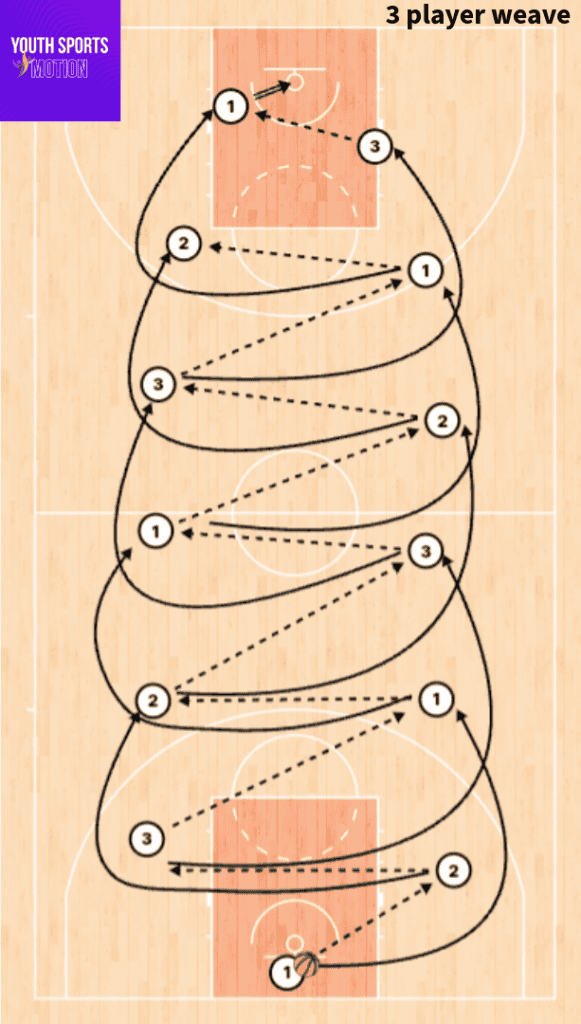
For the third progression, we use a drill called “Weave”. It incorporates moving without the ball. After the pass players must move to different position, rotating from side to side.
“Weave” Passing Drill
In our basketball passing sessions, we often run this drill with groups of three players, though it can also be effectively done with five.
Players line up on the baseline of the backcourt – one on each side and one in the middle. The middle player starts with the ball and passes to either side. After making the pass, the middle player runs behind the back of the teammate who received it.
The drill continues with constant movement: each time a player makes a pass, they immediately run behind the back of the receiver. The ball and the players move side to side until the sequence ends with a lay‑up.
There is no dribbling involved – only passing. Each pass must be quick, accurate, and delivered at chest height, just in front of the receiver so they can catch it in motion. Communication is critical, as is timing for the lay‑up. A common mistake is finishing too far from the basket or too close, making the lay‑up uncomfortable. Coaches should emphasize communication, accuracy, and reading the right timing for the finish. Players must avoid unnecessary extra passes and focus on clean execution.
Basketball Passing Fourth Progression Drill: Game Application
Every skill has to progress from isolated practice to real game application. During games, coaches should encourage players to try different types of passes to apply what they learned in training. A coach can stop play briefly to remind players of the correct technique, but the game shouldn’t be interrupted too often or for too long – players need the chance to learn from their mistakes.
Small‑sided games like 3×3 are perfect for this. They give players more opportunities to pass, receive the ball, and stay involved in the action. This format helps reinforce passing fundamentals while also allowing the coach to focus more closely on individual players, observe their passing during the game, and evaluate their performance.
Common Basketball Passing Mistakes
Wrong Pass Selection
One of the most common passing mistakes in basketball is choosing the wrong type of pass for the situation, which often leads to turnovers. For example, a chest pass to a teammate 8–10 meters away with a defender halfway into the passing lane is not the best choice; in that case, an overhead pass would be more effective. On the other hand, a bounce pass to a teammate just 3 meters away on the perimeter would unnecessarily slow down the attack when a crisp chest pass is available.
These poor choices are part of the learning process and part of the beauty of the game. In youth basketball, we see this more often, but that’s exactly why coaches are there – to help players understand the game better, learn from their mistakes, and progress faster.
Rushed Passing
Another common passing mistake in youth basketball is the rushed, stressed pass. In training sessions, we often see players make hurried passes when they feel defensive pressure and want to get rid of the ball quickly to avoid being trapped.
To prevent this, coaches should design sessions where players must handle the ball under pressure. Over time, this helps them grow comfortable when pressed by defenders. Coaches also need to teach technical skills such as the retreat dribble, which allows players to escape pressure and reposition themselves for a better pass.
At the same time, teammates must do their part by working hard to get open. When receivers create clear passing lanes, the passer can deliver a composed, accurate pass instead of panicking under pressure.
Footwork Mistakes in Passing
Passing isn’t only about the hands; footwork plays a huge role in creating the right angle and space. One common mistake is not lunging enough when making a one‑hand side push pass. Without that step, the passer fails to create enough open space for the ball to travel through the lane.
Another frequent issue is poor pivoting. Players either don’t pivot at all or don’t pivot enough to open up the correct passing angle. As a result, they limit their options and make themselves easier to defend.
Coaches should emphasize that proper footwork – lunging, stepping into the pass, and pivoting to adjust angles- is just as important as hand placement and power. Good footwork creates passing lanes, keeps defenders off balance, and makes every pass more effective.
Telegraphed Passes
Sometimes players do everything technically correct, yet they still lose the ball when trying to pass to a teammate. We see this often in real basketball sessions. A player may execute a technically sound pass, with proper posture, hand placement, stance, and power, but the ball still gets intercepted. The reason is that the passer made it obvious to the defender where the ball was going. Body language and even eye movement can give away a player’s intention. This is called a telegraphed pass.
Coaches need to explain to players how their body language, face expression and eyes appear to others. Passing isn’t only about mechanics, it’s also about disguise and awareness. Players can’t see themselves in action, so it’s the coach’s job to teach the concept of telegraphing and help them understand how predictable they might be.
We can help players make their passes less predictable by reminding them not to stare too long at the intended receiver. Once eye contact is made, the pass should be immediate, without hesitation, if that’s the passer’s intent. Coaches should also encourage the use of fake passes to throw defenders off balance and open passing lanes. More advanced options include the no‑look pass, though it carries more risk of inaccuracy. Ultimately, much of this awareness comes from playing regularly, learning to read the game, recognize patterns, and understand teammates’ movements. But coaches play a vital role in speeding up this process by guiding players, pointing out mistakes, and helping them become more aware of themselves and their surroundings.
Beyond Skill: Passing as a Mindset
Shooting and dribbling can be done alone, but passing always requires two. That’s why passing is the true synonym of teamwork. It’s more than just a skill – it’s the foundation of a successful team. It requires patience from the coach and from the players, but it’s the coach’s responsibility to make players see that passing is not just a drill, but a mindset.