
Basketball Officials
Basketball is not only governed by rules for players but also by the officials who administer the game. Under Rule Eight: Referees, Table Officials, Commissioner of the FIBA 2024 Official Basketball Rules, the management of the game is entrusted to a collective of referees, table officials, and a commissioner (if present). Each role carries specific responsibilities that ensure fairness, accuracy, and smooth game flow.
Hierarchical Roles: Crew Chief and Umpires
The officiating team is led by the crew chief, supported by one or two umpires.
- Crew Chief’s Powers:
- Inspects and approves equipment before the game.
- Designates official clocks and identifies table officials.
- Selects the game ball.
- Holds authority to stop the game, determine forfeits, and make final decisions when referees disagree.
- General Referee Duties:
- All referees can make decisions on infractions inside and outside the boundary lines.
- No referee may disregard another’s decision; the crew chief intervenes only in cases of disagreement.
- Duration of Authority:
- Referees’ power begins 20 minutes before tip-off and ends when the crew chief signs the scoresheet after the game.
Operating Principles
Referees must uphold four guiding principles:
- Spirit and Intent: Protect the integrity of the game.
- Advantage/Disadvantage: Avoid penalizing incidental contact that does not affect play.
- Common Sense: Apply consistency with awareness of player abilities and attitudes.
- Game Control vs. Flow: Balance discipline with maintaining rhythm.
Coordination with Other Officials
Referees work closely with table officials and the commissioner:
- Commissioner: Supervises table officials and assists referees in ensuring smooth game operation.
- Table Notification: Table officials must alert referees about critical infractions (e.g., 5-foul limit, disqualification, substitution errors).
- Correctable Errors: Referees stop play to fix administrative or shot clock errors, often consulting table officials.
Technical Procedures and Equipment
- Instant Replay System (IRS): The crew chief decides when IRS is used, typically with the umpire who made the call.
- Scoresheet: Umpires sign first; the crew chief signs last, officially ending their connection with the game.
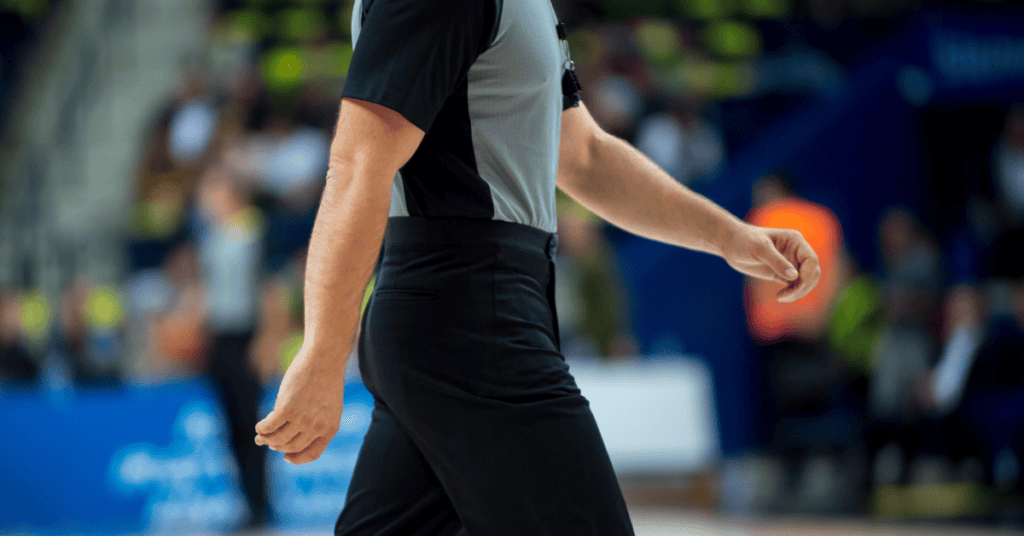
- Uniforms: Referees wear standardized attire: shirt, long black trousers, black socks, and black basketball shoes.
- Language: For international games, referees must use English when verbal communication is necessary.
Table Officials
The officiating team also includes table officials: scorer, assistant scorer, timer, and shot clock operator.
Scorer and Assistant Scorer
- Scorer Duties:
- Maintains the official scoresheet.
- Records player names, numbers, starting five, goals, free throws, and fouls.
- Alerts referees when players reach the 5-foul limit or coaches face disqualification.
- Tracks time-outs and operates the alternating possession arrow.
- Assistant Scorer: Operates the visual scoreboard and assists the scorer and timer. If discrepancies arise, the scoresheet takes precedence.
Timer
- Manages the game clock and stopwatch.
- Ensures loud automatic signals at the end of quarters.
- Uses foul markers (1–5 for players, red after 4 team fouls).
- Notifies referees of substitution and time-out opportunities.
- Strictly follows rules for starting/stopping the clock.
Shot Clock Operator
- Controls the offensive pace with the shot clock.
- Resets to 24 seconds: After a goal, opponents gain control, or a backcourt throw-in is awarded.
- Resets to 14 seconds: After the ball touches the ring and the same team regains control, or following certain frontcourt throw-ins.
Broader Context and Responsibilities
- Table officials share responsibility for game integrity and must notify referees of errors.
- They must be uniformly dressed and coordinated with the crew chief.
- At the end of the game, all table officials sign the scoresheet; the crew chief signs last to finalize administration.
The Commissioner
The commissioner is an optional member of the officiating team whose primary role is to ensure administrative integrity and smooth execution of the game. While referees handle on-court action, the commissioner provides supervisory oversight and support.
Primary Duties and Positioning
- Location: Sits at the scorer’s table between the scorer and the timer.
- Supervision: Oversees the work of table officials to ensure accuracy.
- Assistance: Supports the crew chief and umpires in maintaining game flow.
- Rules Adherence: Must conduct the game strictly according to the rules, with no authority to change them.
Interaction with Referees
- Disagreements: The crew chief may consult the commissioner when referees disagree on a call.
- Instant Replay (IRS): Before an IRS review, the crew chief gathers input from all officials, including the commissioner.
- Referee Injury: If an on-court official is injured, referees consult the commissioner regarding replacements.
Administrative and Reporting Authority
- Protests: Records the time protest reasons are received and submits a written report to the organizing body.
- Major Infractions: Reports forfeits, disqualifying fouls, or unsportsmanlike behavior occurring outside the standard game window.
- Correctable Errors: Helps identify errors in scoring or clock operations. If not corrected within time limits, must send a detailed report to the organizing body.
General Expectations
- Commissioners are expected to demonstrate ethical behavior and play a positive role in the game.
- Share responsibility with referees and table officials to notify immediately if inaccuracies in scorekeeping, timekeeping, or shot clock operations are detected.
Rule Eight emphasizes the collective responsibility of referees, table officials, and commissioners in managing basketball games. While referees enforce rules on the court, table officials ensure accurate records, and commissioners provide oversight and reporting. Together, they safeguard the fairness, discipline, and integrity of the sport.